Colours
February 18, 2026
I’ve seen this picture that compared the colours of walls across decades, with the 1920s until the 1970s being the most colourful, and all the decades until now increasing in neutrality. It is unfortunate that we have lost colour and we must remedy this, but there is a good reason this happened.
Paradoxically to what was pointed out, we do see a wide gamut of colour on the daily. How long a day do you stare at a screen, itself an incredibly bright, colourful slate? What was once a luxury, a great assortment of colours, isn’t any longer. We can generate them with ease. We have grown used to the omnipresence of strong colours through our screens, and therefore what is devoid of colour has become novel. I bought a pair of headphones that I felt resplendent to look at because it was a new tone of white in what was before a series of metallic blues, greens and pinks.
It also doesn’t help that the incredibly bright, colourful slates we look at all day are the main providers of colour, itself something that is attractive and captivating of attention. One trick that helps some people with reducing their screen-time is turning on the grayscale filter that is sometimes available on their brand of device. With an environment devoid of colour, we naturally like our screens more for they provide them. Perhaps if we filled our environment with more colour, we would struggle less with our mental dependence on our computers and our phones.
Scared of the past
February 13, 2026
Lots will say that they are scared of the future, but I have always been afraid of the past. The past is where things weren’t made, the past is where my effort had yet to be spent; to be promptly returned to a moment in the past where I didn’t have the same friendships, realizing in terror that they do not know me, is my most anxious thought, my nightmare. Even though it would materially be as if they’ve yet to know me, to me, it would be as if they have forgotten about me, or possess an understanding of me that is not as developed. In a way, picture the dementia of a parent and the sadness it creates in their children, how they come to forget what has been previously most precious to them. This, I feel when I imagine an hypothetical time-travel to the past. If I were given the opportunity to safely travel to the past in a time machine, I would categorically refuse.
I think similarly of the oft-thought fantasy to return to the past to correct mistakes made. We sometimes think this would be great, but it would a risky play, a messing with the butterfly effect that has otherwise yielded all happinesses from then until now. Not everybody can sympathize, indeed great ills may have come to others that to them warrants a radical alteration of their present, but I wouldn’t want this to myself, even if it makes me poorer, sicker, or in general less fortunate. I do not wish to change what I have experienced, even if the road has been painful. In this thought, I possess and reflect no regrets.
Remote connection
February 12, 2026
The ever-increasing personal connections with people far away that cannot in any way resolve into real, physical presence might as well be the bane of this generation and generations to come. It is torturous for man, eternally desiring of connection, to have to content himself with the virtual. Some are content with the virtual, some submit and lessen the inner significance otherwise attached to physical, present connection, but those that do not, those who, like the ancestral and historical man, crave to be with those they love, it is pain, full and entrenched. This pain is beyond a superficial skin wound, it isn’t simply a raw feeling but also conducive to a new class of communication, a new manner of interaction that renders the traitorous and the jealousy of the heart, once repelled by moments of closedness, immanent and permanent, fixed to the friendship or the relationship as stars appear fixed to the firmament.
With your loved ones, as they are with you and you with them, their attention is provided, undivided, to you, in a manner that contributes to the flourishing of the relationship found therein. In that given moment there is no intrusion, direct or indirect, willed or accidental, of any other man or thing unallowed or unexpected that would stain or perhaps even remove the color of intimacy that otherwise painted it. Alone, without the possibility of intrusion, communication becomes impartial to the beholders; it is the temporary fixed idea, the focus of the moment, that which can persist for an unlimited time until the soft wind of responsibility hints you to other things. In contrast, with the new class of communication, the new manner of interaction, you are never truly alone; all communication is subject to be yielded, paused and transitioned at any point to something or someone else, as one can intrude at will. It may even be shared as you speak, and you would be none the wiser as to who is there. This is what creates the jealousy, and in a way, the competitive sentiment that one must always perform better than the next intrusion, who can unforeseenly come and get their friend’s attention. It is only the purposeful and willful blocking of notifications that can recreate the ancestral condition of interaction.
Despite describing it as a new class, it isn’t truly new. Men have penned letters since the dawn of time. What makes it worthy of being new is its omnipresence and how it has become, for all intents and purposes, the main mode of communication for our generation. It hurts us and degrades the innate intimacy and the important bond-forming that alone communication creates. This is one symptom of many, such as the unreasonable expectation of the immediacy of reply, which I also wish to write about at some point.
The thin boundary
Feburary 7, 2026
Someone wrote that the advent of quasi-universal automated translation is leading to the breakdown of the language barrier. Everyday I walk by people that speak Chinese, Greek and Ukrainian, and I understand none of it. I also do not have any kind of tool on me that translates it all and feeds it to me. Clearly, the language barrier is still there and most likely will be for eternity, but then I wondered why is it that they thought that? What exactly creates the impression that the language barrrier is gone? Sure, I can selectively translate that which I read online, but this is in no way the breakdown of the language barrier altogether. Surely this is known and therefore any claims to its breakdown is a willful exaggeration, but not really.
I’ve come to understand, sadly so, that the boundary separating the real from the Internet and the social media that compose it has grown quite thin in the minds of the people. It is to the point that online communication is perceived as so equal to real communication that any difference is consequently felt to be marginal. A reduction in the online language barrier is therefore equal to a reduction in the real language barrier. Of course, there are worlds of difference between the two: real communication is more effective, draws much nearer to the heart, and is much more complex in both tone, interpretability, and its impact on the mind, whereas virtual communication is more stern, colder, serves more as a store of information, and has a much broader tolerance for conversational timing.
Despite the differences between the two, lots no longer understand how one is so unlike the other that such things as language barriers also become their own independent instances, with different dynamics and social considerations. The virtual language barrier is different than the real language barrier in many ways; character representation alone can color the consequences of the language barrier and its potential as an obstacle, with different fonts sometimes altering interpretation. This does not exist in person-to-person communication, taking away what is otherwise a print-only obstacle. Yet, even this is no longer taking away from the noticing of the difference. It is straightforward at this point to see that people are forgetting the difference between the real and the virtual.
And when pointed out, there is a strange refusal to see. The more rational will argue that both are closer than we think while retaining a degree of admittance that they are still fundamentally different, but most will be quicker to rashly state that they are, in fact, the same, even if only for intents and purposes. It is plain in their motivations that this is more of a wish than an observation; they want this, and their want transforms into a loaded observation, as if to manifest a reality that is otherwise missing. Those that often defend the virtual as tantamount to the real are also those that have the most active investment in the virtual, and possess either a strong dislike for the real or a passive indifference at the least. The boundary already made thin is torn by the rejection of the real in favour of the virtual, of the fake that creates for them a reality they prefer most.
Denomination Hopping
February 5, 2026
Richard Ackerman has spoken about this at length, but I’m unsure whether he perceives the true cause of denomination hopping.
Denomination hopping is when somebody, usually someone young, transits quickly between individual Christian denominations, occasionally visiting other religions as well such as Islam. This is downstream of postmodernism; opinions notwitstanding, it considers everything interexchangeable and of equal value, therefore convincing the religiously inclined of Generation Z to convert to Lutheranism or Anglicanism or even Ahmadiyya Islam on a whim. It reduces the whole of religion to clothing, to a shirt-change; one day, I will wear the red shirt of Presbytarianism, and the other day, I will wear the yellow shirt of Catholicism.
This occurs because Generation Z does not believe in anything truly. It believes that it believes, but it clearly does not when it sacrifices what it otherwise calls a strongly held value on the altar of conversion every fortnight. What they believe becomes secondary or even tertiary to the other aspects of the religion, such as its aesthetics, their opinions of its community, the length of its services, and all that which accessorizes the faith but does not constitute the faith. The same applies to just about any other ideological undertaking, with many changing and adjusting their politics on the regular as a new opinion comes down the pipeline of social media.
Denomination hopping then follows suit; one grows bored of their religion then becomes something else. Seldom have they even gone to church to begin with, perhaps visiting once or twice but ultimately retaining only an online faith of little material significance. The identity is borne and acted upon in arguments but nothing else. Belief, in the end, remains only but a fading hope of what they originally wanted but found they couldn’t achieve, and rather than facing the reality of their decaying belief, would rather uphold pretense and lie to themselves that in time they will believe eventually, maybe after this one strong argument.
Of course, this is nonsense. The only way to discern faith is to find out what you are willing to believe in. It’s an active, not passive, process, even if you believe that it’s ordained instead of willed. If you find yourself hopping between denominations and find it disturbing and quite the imperfect situation then all that you need to do is sit for a while and ask of yourself what you are willing to believe. If you err on a thought and consider it a cautious “maybe” even after much study then no, you do not believe that, and therefore you do not belong there. You need to seek something else. If you’re chartering the values of each denomination as a binary of pros and cons then you are approaching this erroneously.
Go down the list of what a denomination believes, which you can usually find summarized in their individual confessions, and ask of yourself for each, “am I willing to believe this?”. You do not have to believe it now, because perhaps you’ve yet to study more. But if you pursue one of these, and you always find some lingering doubt at the back of your head that you cannot ever become convinced of, then move onto something else. If you’ve exhausted all candidates, then maybe you have simply never believed, and indeed it was all pretense. Was it only an identity for you, or something greater?
Generation of the Brown Paper Bag
January 31, 2026
When I was in grade school, I remember going through waste management classes where we learned how to properly recycle, which kinds of recyclables there are, and the impacts of garbage on the health of the environment. Accompanying this was general education on how to responsibly consume, re-use as much as possible, and seek alternatives that wouldn’t produce as much trash. Ideally, you would go through your week without even filling half a black garbage bag. And to what result? Every time I see a littered Generation Z home, it is always chockful of delivered garbage. Brown paper bags absolutely everywhere, the molted skins of meals past. It all gets put into some kind of big bag at the end of the week—rare is the adult of my generation that cleans after himself regularly!—and thrown into the bin.
The consumption habits of the previous generation have socially reproduced themselves fairly visibly into Generation Z, but not so much the cleaning. Cleaning as a form of discipline has clearly not been passed down; I’m unsure why. Even I was behind my cleaning habits as a teenager but I corrected them as I started dating in high school. I believe that most of Generation Z stands without impetus to clean as the disconnect tainting us reduced the opportunities for socialization at home, with much of the talking done entirely through the screen. The natural coercion to appear clean is no longer there, and in time, may disappear altogether as an expectation between peoples. It is important that we find the urge to be clean, to have homes free of trash, ordered and mopped and broomed and smelling nice.
Shiloh Hill
January 25, 2026
I feel like a stranger to what’s happening down south in the United States, not necessarily because I am not there, but because for years I’ve felt a quiet sadness over the tension and the conflict. This is a disappearing emotion as many enlist themselves for conflict and for confrontation instead of resolution. They rarely put it in these words, however; they label the conflict as the act of resolution, and that without conflict, there would only be a continuation of the pre-existing, growing harm. Suggesting anything else but conflict is antagonizing; desiring a lack of violence becomes a violence in itself. This is, of course, nothing new. The status quo is adored once and vilified next until conflict transforms it, and then it repeats.
Personas
January 14, 2026
I’ve seen this picture:
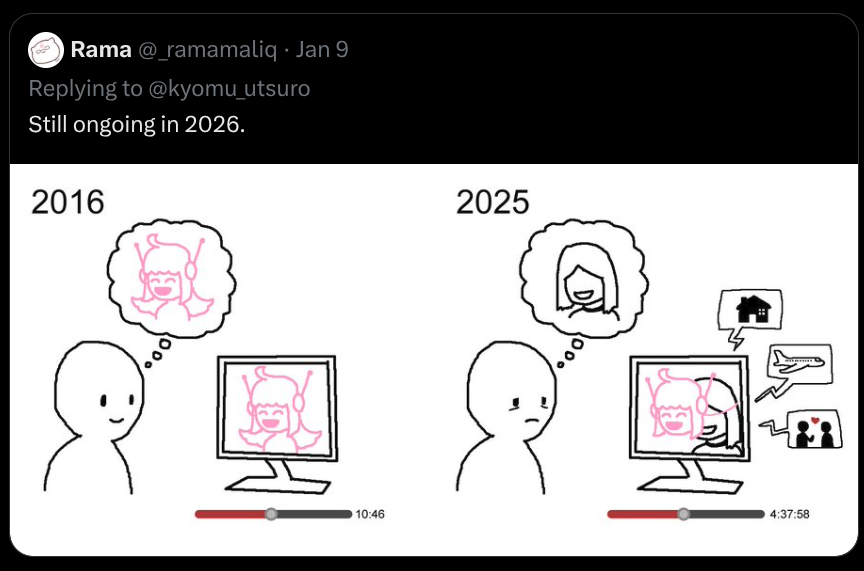
People seem to be having offense over this because they interpret it as criticism when they should be seeing it as a warning. Parasocial relationships are a timeless error of our innate will to connect with others; the pretense of connection through displays of niceness is too easily mistaken for real connection, and you need to be careful when regularly engaging with online personalities because the echo chamber of attention and approval they provide can become dangerously intoxicating. Anonymity allows some people to confer endlessly on each little detail of their lives, something which is generally only dispensed between very close friends; those that do not have close friends will be naturally drawn to this as this closedness is missing from their lives.
This is what seems to be conveyed in the picture. The person, initially, loves the avatar, but then ends up loving the person behind the avatar as they gain wide knowledge of who they are and what their lives are like. Lacking this kind of friendly exposition from the real connections they have, they find the online engagement with the person somehow more fulfilling, even if only from a postmodern, semi-sarcastic and self-deprecating perspective. This is the danger, the unhealthy problem that, unfortunately, is only natural provided the increasingly disconnected society we’re eerily progressing into. I don’t believe this is demeaning of those that are engaging in this behavior, but too often warnings are seen as criticism.
Not having
June 13, 2025
There is a great deal of greatness in not having something. I was thinking of a flower I’ve seen a few days ago, reminding myself of how much happiness it brought me, and I felt it was a shame I didn’t have it with me. I imagined placing it on my windowshill so it can drink in all the sunlight, and the nice shades of red it would give off. Sadly, I’m a bad gardener, and it would likely die if I were to take it from the place that makes it bloom best. So, I enjoy it, but in the place that it deserves to be. I recognize that it is best for it to stay there and for me to drape over my envy.
Marble
May 2, 2025
Why is it that the tellers of a story always want to write what’s next? I write bits of fiction and I found that, after a while, I exhaust my creativity and become unable to extend the story forward. I can keep vomiting more words out, but it’ll bad. When I’m satisfied with my story, I sometimes feel like there should be more to it, but really, most of the time, it shouldn’t be. The goodness of a story is a quantity that dilutes when it grows too wordy; it is a marble that you chisel into form, but if you keep on subtracting from the rock, it eventually turns to nothing.
Google Dockey
April 27, 2025
The most vile part of today’s neo-puritanism is how there is no longer any mechanism for society to move on from shock. I read up how headliners and controversies from celebrities were handled in the pre-Internet age, and it usually involved a three-step process where first, the shocking information was disclosed to the public through television or newspaper, second, the celebrity acknowledges, debates, or refutes the information, and third, the celebrity eventually does some compensatory act that the public generally finds redemptive. Afterwards, regardless of whether we found that the celebrity purged themselves to the extent we wanted, society digested what happened and moved on. The controversy lasted for a time then expires, even though it’ll always remain documented in biographies for people to find out.
We don’t really have this mechanism anymore, do we? Today’s controversies are made timeless by the Internet. Shocking revelations are presented without time or space, rendering them immortal and subject to being shocked back into relevance when somebody decides to remind everyone else that hey, this person did that. If they catch you enjoying a song or a book from someone that once did something very controversial, you can’t tell them to “move on”, or that at least you’ve moved on. If you decide to press on with your enjoyment of what they made, that necessarily constitutes unconditional support of the person and complete agreement with what they’ve done. You remain a jurist of the court of public opinion, but no longer able to cast a judgement of your own. You must abide by what everyone else voted for.
The other nasty evolution of neo-puritanism is how blunted the efficiency of responses and discussion became. I remember a time where when controversies and hit pieces were revealed, there was ample time to talk of them and elaborate them. You always had a few blindly believing the headline but at least most would do a little intellectual investment into the what’s-whats and produce an opinion thereafter. Those opinions would be influenced by some of the independent discussion that occurred after the news broke out, which is conducive to making rational and elucidated conclusions. This, however, no longer exists, or at least ceased to exist in an efficient and useful form. Nuance isn’t possible anymore when you must either believe or refute what’s been presented, with no possibility of further developing the evidence and positions held by the hit piece.
And then, there’s the culture and protocols it created, which are funny more than anything else. Breaking out a controversial factoid before was magnifying a rumor that spread too far, rashly edited and printed onto the covers of magazines just in time prior to next week’s distribution. Today, it’s a formal ritual involving the well-margined, typeset writing of a Google Docs, or the careful production of a website entirely dedicated to the controversy, almost complete with peer-review, journal publication, and ISBN identifiers. Examining somebody’s conscience, solely to cast them out of their comforts for the sake of the alleged hurt, is now a pseudo-empirical research process more than a rumor-gasp-headline publicity event. If it fails at popularity, it will be re-hashed again with different variables.
The bar for evidence has been significantly lowered too, with people immediately and uncritically believing in, for relevant example, Discord screenshots that most now somehow believe cannot be falsified in any way. Strangely enough, when it was harder to edit pictures, people used to be less gullible and believing of content they saw on the Internet. Now, with image editing and content generation available to everyone, you can post a screenshot of a couple messages, and for some reason it’ll be widely taken as truth. When some of today’s philosophers say that we live in a post-truth world, we think that it’s because it became too easy to dispense “alternative facts”, but maybe it’s also because we no longer hold reasonable suspicion of what we’re told. It’s no wonder conspiracy theories have grown so widespread.
Em dashes
April 24, 2025
I found that an abundance of em dashes (—) correlates highly to LLM-generated text. Em dashes are a useful, arguably underrated form of punctuation, and I do make use of them from time to time, but LLMs tend to insert em dashes where semicolons would be more appropriate. Almost every single output by popular LLMs just spam em dashes wherever at the expense of commas, semicolons, colons, and shorter sentences altogether. As I read more and more AI bullshit, I feel that I’m growing increasingly capable of detecting it, but the em dash sign is such a strong indicator that you can approach this detection almost mechanically.
Gatekeeping
April 23, 2025
I’ve briefly argued with somebody who thought that Hiroshi Kawamata’s adaption of Anne of Green Gables into an animation will “expose” the classic book to a modern audience, and somehow, that’s bad. I rejected the idea because of its stupidity; shouldn’t good and pure things be what we try to project into the future so younger people can inherit them and pass them on? According to him, today’s people are not deserving of the classics, or incapable of even comprehending them, and therefore should limit themselves to the slop that’s mass produced today. This is the exact kind of vile thinking that hurts tradition and the quality of not only our people but also our living. With a few exceptions, such as parts of nature we really don’t want human presence around, it is good for good things to become popular, or at least more accessible in some way, because then it embeds more permanently into our heritage. I see similar gatekeeping with music, games, even food and restaurants, and all of it is stupid. I understand the satisfaction of being part of a niche, but I decline to feel irritated when my niche becomes successful, because while we may feel like that out of a desire to preserve, it is ultimately born out of self-centeredness.
Goodness
April 23, 2025
There are a lot of “black and whites” philosophies—what academics call dichotomies—and I’m fascinated the one that speaks of whether humans are good or bad, because it provides so much insight into systems of ideas that are affiliated despite sounding separate. See, some consider humans to be inherently bad, but can be made good, while some others consider humans to be inherently good, but can be made bad. Capitalism is an instance of the former; it assumes that humans are naturally self-centered, and it renders that self-centeredness conducive to the formation and maintenance of a society via money and property. Someone can surrender their autonomy for a time to receive the medium through which they can fulfill their selfish desires, and criminality is simply someone unwilling to obey the rules to gain an unfair advantage. Socialism, on the other hand, assumes that humans are naturally cooperative, and self-centeredness is actually the result of a very competitive society that pits worker against worker; criminality, in turn, becomes a side-effect of that intense competitiveness, and all ills can be resolved through resolving class differences and wealth disparities. Whether one or the other is right is a debate that rages on to this day and I’m badly placed to even have an opinion on the matter, but if you think carefully, you will see why some things which seem opposed end up related.
Take, for example, Christianity. It is a religion of intense charity, tolerance, and brotherhood; it rejects self-centeredness over self-sacrifice. It is normal to assume that it would be associated with socialism and other ideologies that also preach against egotism and for the equity of people. Yet, while some Christians have been socialists and communists in history, Christianity has mostly been supportive of capitalism. Part of it has to do with socialist states of the twentieth century promoting fervent atheism, but that is not always the reason cited. You can look at, for example, Pope Pius XII’s decree against communism, or G. K. Chesterton’s belief that Catholic encyclicals condemned socialism. It seems bizarre that Christianity, denying self-centeredness, would promote capitalism, promoting of self-centeredness, but it ceases to be confusing when you realize that capitalism and Christianity both align on the dichotomy of human goodness. Capitalism assumes that we are naturally evil and self-centered on the basis of human nature; Christianity shares that belief on the basis of sin. It is this similarity of belief that creates the weird, subtle connection between capitalism and Christianity.
Does this mean Christians should be capitalists and reject socialism? No, because that subtle connection doesn’t mean anything beyond being an indicator of mode of thought. Someone that is capitalist and believes that human beings are naturally evil is more likely to agree with Christianity on that basis, and likewise, someone that is Christian and believes that human beings are naturally evil sinners is more likely to agree with capitalism’s similar assumption of human nature. Now, this shouldn’t be taken as a statement of support for socialism either, but simply an observation of how a Christian—someone that should practice intense charity—can come to embrace an economic system that is, at its core, devoid of it. Whether that subtle alignment on the nature of humanity should factor into your ideology is entirely a personal decision.