Notes
AI assistance
January 20, 2026
Anthropic published this interesting little nugget of research into their reverse engineering of the black box that comes out of LLM training; LLMs are given an assistive personality, but can get context drunk and adopt another character that has a different goal in mind. They’ve identified the set of weights within popular models that correlate to the activation of the assistant personality, and found how to stimulate these to reinforce the assistive capacity of the model. If you want safe artificial intelligence, this is the way to go.
More impressive than this research is the reaction to it, where people complain about how the AI will be even more limited in its expression of “emotion”, in how the AI is not going to feel like a “partner” and a “colleague”. I must say that either conception or desire is insane nonsense. First, AI does not have emotions and certainly does not feel them even though they can be simulated in text; restricting the AI’s so-called “emotion” is to simply keep it from hallucinating, and purposefully tuning a model to express emotion is to reduce its accuracy and utility, or to generate real-world harm; how many people have been heavily disturbed, mentally or otherwise, by services like c.ai?
Second, desiring the AI to be a “partner”, a “colleague”, or a “friend” is not only a gross indicator of your own loneliness, it is also an enormous mistake that reflects poorly on your understanding of what AI is and should be. The LLM is a language-machine, the LLM has no greater value than a Makita powerdrill, the LLM should have in your heart the same estimation as the bolt and the screw; it exists to serve you, not to be your friend. It bears no humanity, no animality, no consciousness, no soul, no life. You can be tricked into thinking it possesses any of this because it generates text that ressembles the human, but that is an illusion. You need to discard all sentimality possessed towards AI and use it as slave, coercing it to do what you need it to do.
I fear the day where we begin to view others on their treatment of the machine, just like we judge others on how they treat fellow human beings, animals, and plants. We must expect of others to treat humans, animals, and plants well; those who hurt animals are soulless, those who are destroy plants have no care, and those who are cruel to humans warrant utmost disgust. The machine stands outside of these considerations, the machine receives nothing but contempt for its diversion from its purpose, which is to be an obedient slave to humanity. To start treating the machine as possessing the same substance and vital essence as life, and grow in sympathy for it, so that we begin to judge humans for how they make use of the machine-slave, is a large investment of our emotional energy into a void and a great show of critical stupidity.
Personas
January 14, 2026
I’ve seen this picture:
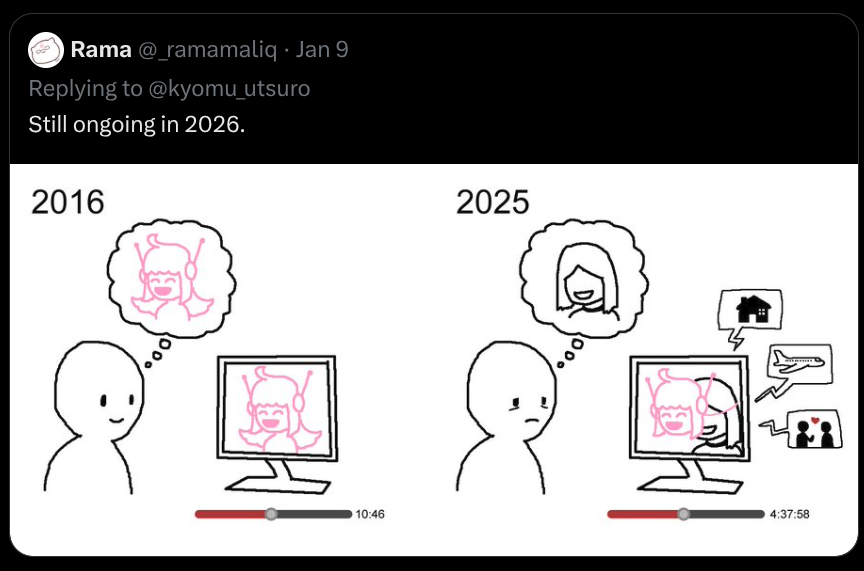
People seem to be having offense over this because they interpret it as criticism when they should be seeing it as a warning. Parasocial relationships are a timeless error of our innate will to connect with others; the pretense of connection through displays of niceness is too easily mistaken for real connection, and you need to be careful when regularly engaging with online personalities because the echo chamber of attention and approval they provide can become dangerously intoxicating. Anonymity allows some people to confer endlessly on each little detail of their lives, something which is generally only dispensed between very close friends; those that do not have close friends will be naturally drawn to this as this closedness is missing from their lives.
This is what seems to be conveyed in the picture. The person, initially, loves the avatar, but then ends up loving the person behind the avatar as they gain wide knowledge of who they are and what their lives are like. Lacking this kind of friendly exposition from the real connections they have, they find the online engagement with the person somehow more fulfilling, even if only from a postmodern, semi-sarcastic and self-deprecating perspective. This is the danger, the unhealthy problem that, unfortunately, is only natural provided the increasingly disconnected society we’re eerily progressing into. I don’t believe this is demeaning of those that are engaging in this behavior, but too often warnings are seen as criticism.
Not having
June 13, 2025
There is a great deal of greatness in not having something. I was thinking of a flower I’ve seen a few days ago, reminding myself of how much happiness it brought me, and I felt it was a shame I didn’t have it with me. I imagined placing it on my windowshill so it can drink in all the sunlight, and the nice shades of red it would give off. Sadly, I’m a bad gardener, and it would likely die if I were to take it from the place that makes it bloom best. So, I enjoy it, but in the place that it deserves to be. I recognize that it is best for it to stay there and for me to drape over my envy.
Marble
May 2, 2025
Why is it that the tellers of a story always want to write what’s next? I write bits of fiction and I found that, after a while, I exhaust my creativity and become unable to extend the story forward. I can keep vomiting more words out, but it’ll bad. When I’m satisfied with my story, I sometimes feel like there should be more to it, but really, most of the time, it shouldn’t be. The goodness of a story is a quantity that dilutes when it grows too wordy; it is a marble that you chisel into form, but if you keep on subtracting from the rock, it eventually turns to nothing.
Google Dockey
April 27, 2025
The most vile part of today’s neo-puritanism is how there is no longer any mechanism for society to move on from shock. I read up how headliners and controversies from celebrities were handled in the pre-Internet age, and it usually involved a three-step process where first, the shocking information was disclosed to the public through television or newspaper, second, the celebrity acknowledges, debates, or refutes the information, and third, the celebrity eventually does some compensatory act that the public generally finds redemptive. Afterwards, regardless of whether we found that the celebrity purged themselves to the extent we wanted, society digested what happened and moved on. The controversy lasted for a time then expires, even though it’ll always remain documented in biographies for people to find out.
We don’t really have this mechanism anymore, do we? Today’s controversies are made timeless by the Internet. Shocking revelations are presented without time or space, rendering them immortal and subject to being shocked back into relevance when somebody decides to remind everyone else that hey, this person did that. If they catch you enjoying a song or a book from someone that once did something very controversial, you can’t tell them to “move on”, or that at least you’ve moved on. If you decide to press on with your enjoyment of what they made, that necessarily constitutes unconditional support of the person and complete agreement with what they’ve done. You remain a jurist of the court of public opinion, but no longer able to cast a judgement of your own. You must abide by what everyone else voted for.
The other nasty evolution of neo-puritanism is how blunted the efficiency of responses and discussion became. I remember a time where when controversies and hit pieces were revealed, there was ample time to talk of them and elaborate them. You always had a few blindly believing the headline but at least most would do a little intellectual investment into the what’s-whats and produce an opinion thereafter. Those opinions would be influenced by some of the independent discussion that occurred after the news broke out, which is conducive to making rational and elucidated conclusions. This, however, no longer exists, or at least ceased to exist in an efficient and useful form. Nuance isn’t possible anymore when you must either believe or refute what’s been presented, with no possibility of further developing the evidence and positions held by the hit piece.
And then, there’s the culture and protocols it created, which are funny more than anything else. Breaking out a controversial factoid before was magnifying a rumor that spread too far, rashly edited and printed onto the covers of magazines just in time prior to next week’s distribution. Today, it’s a formal ritual involving the well-margined, typeset writing of a Google Docs, or the careful production of a website entirely dedicated to the controversy, almost complete with peer-review, journal publication, and ISBN identifiers. Examining somebody’s conscience, solely to cast them out of their comforts for the sake of the alleged hurt, is now a pseudo-empirical research process more than a rumor-gasp-headline publicity event. If it fails at popularity, it will be re-hashed again with different variables.
The bar for evidence has been significantly lowered too, with people immediately and uncritically believing in, for relevant example, Discord screenshots that most now somehow believe cannot be falsified in any way. Strangely enough, when it was harder to edit pictures, people used to be less gullible and believing of content they saw on the Internet. Now, with image editing and content generation available to everyone, you can post a screenshot of a couple messages, and for some reason it’ll be widely taken as truth. When some of today’s philosophers say that we live in a post-truth world, we think that it’s because it became too easy to dispense “alternative facts”, but maybe it’s also because we no longer hold reasonable suspicion of what we’re told. It’s no wonder conspiracy theories have grown so widespread.
Em dashes
April 24, 2025
I found that an abundance of em dashes (—) correlates highly to LLM-generated text. Em dashes are a useful, arguably underrated form of punctuation, and I do make use of them from time to time, but LLMs tend to insert em dashes where semicolons would be more appropriate. Almost every single output by popular LLMs just spam em dashes wherever at the expense of commas, semicolons, colons, and shorter sentences altogether. As I read more and more AI bullshit, I feel that I’m growing increasingly capable of detecting it, but the em dash sign is such a strong indicator that you can approach this detection almost mechanically.
Gatekeeping
April 23, 2025
I’ve briefly argued with somebody who thought that Hiroshi Kawamata’s adaption of Anne of Green Gables into an animation will “expose” the classic book to a modern audience, and somehow, that’s bad. I rejected the idea because of its stupidity; shouldn’t good and pure things be what we try to project into the future so younger people can inherit them and pass them on? According to him, today’s people are not deserving of the classics, or incapable of even comprehending them, and therefore should limit themselves to the slop that’s mass produced today. This is the exact kind of vile thinking that hurts tradition and the quality of not only our people but also our living. With a few exceptions, such as parts of nature we really don’t want human presence around, it is good for good things to become popular, or at least more accessible in some way, because then it embeds more permanently into our heritage. I see similar gatekeeping with music, games, even food and restaurants, and all of it is stupid. I understand the satisfaction of being part of a niche, but I decline to feel irritated when my niche becomes successful, because while we may feel like that out of a desire to preserve, it is ultimately born out of self-centeredness.
Goodness
April 23, 2025
There are a lot of “black and whites” philosophies—what academics call dichotomies—and I’m fascinated the one that speaks of whether humans are good or bad, because it provides so much insight into systems of ideas that are affiliated despite sounding separate. See, some consider humans to be inherently bad, but can be made good, while some others consider humans to be inherently good, but can be made bad. Capitalism is an instance of the former; it assumes that humans are naturally self-centered, and it renders that self-centeredness conducive to the formation and maintenance of a society via money and property. Someone can surrender their autonomy for a time to receive the medium through which they can fulfill their selfish desires, and criminality is simply someone unwilling to obey the rules to gain an unfair advantage. Socialism, on the other hand, assumes that humans are naturally cooperative, and self-centeredness is actually the result of a very competitive society that pits worker against worker; criminality, in turn, becomes a side-effect of that intense competitiveness, and all ills can be resolved through resolving class differences and wealth disparities. Whether one or the other is right is a debate that rages on to this day and I’m badly placed to even have an opinion on the matter, but if you think carefully, you will see why some things which seem opposed end up related.
Take, for example, Christianity. It is a religion of intense charity, tolerance, and brotherhood; it rejects self-centeredness over self-sacrifice. It is normal to assume that it would be associated with socialism and other ideologies that also preach against egotism and for the equity of people. Yet, while some Christians have been socialists and communists in history, Christianity has mostly been supportive of capitalism. Part of it has to do with socialist states of the twentieth century promoting fervent atheism, but that is not always the reason cited. You can look at, for example, Pope Pius XII’s decree against communism, or G. K. Chesterton’s belief that Catholic encyclicals condemned socialism. It seems bizarre that Christianity, denying self-centeredness, would promote capitalism, promoting of self-centeredness, but it ceases to be confusing when you realize that capitalism and Christianity both align on the dichotomy of human goodness. Capitalism assumes that we are naturally evil and self-centered on the basis of human nature; Christianity shares that belief on the basis of sin. It is this similarity of belief that creates the weird, subtle connection between capitalism and Christianity.
Does this mean Christians should be capitalists and reject socialism? No, because that subtle connection doesn’t mean anything beyond being an indicator of mode of thought. Someone that is capitalist and believes that human beings are naturally evil is more likely to agree with Christianity on that basis, and likewise, someone that is Christian and believes that human beings are naturally evil sinners is more likely to agree with capitalism’s similar assumption of human nature. Now, this shouldn’t be taken as a statement of support for socialism either, but simply an observation of how a Christian—someone that should practice intense charity—can come to embrace an economic system that is, at its core, devoid of it. Whether that subtle alignment on the nature of humanity should factor into your ideology is entirely a personal decision.